
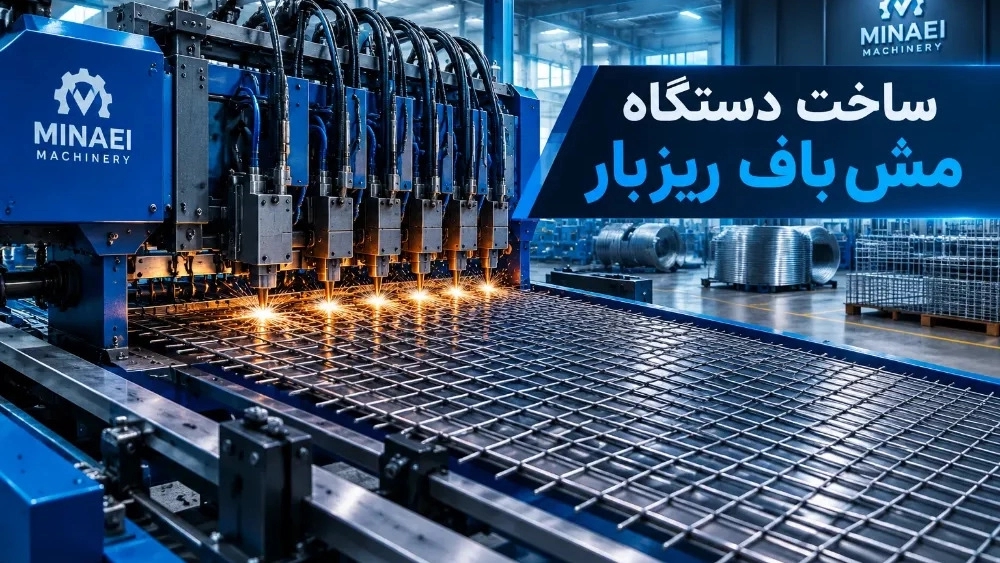
The production of rebar networks and welded nets is one of the important parts of the construction industry and the production of metal products. With the increasing need of high-quality rebar networks in construction projects, the use of accurate and reliable industrial equipment has become more important. In the meantime, making a small mesh weaving machine is an important solution for manufacturers who work with thinner bars and finer networks to increase production speed, improve product quality, and reduce waste.
Rizbar mesh weaving machine is designed with the aim of producing welded meshes according to the specifications required by the customer. The correct selection of this machine can help manufacturers to produce more uniform products, reduce operation time and increase their production capacity according to market orders.
Minai Machining as an active group in the field of manufacturing industrial machinery and mesh weaving machines in Karaj, can be an option for the applicants of this equipment to check the technical needs and order the manufacturing of the machine. Getting to know the features of the microbar mesh weaving machine, the main components, selection criteria and important points when ordering, will help manufacturers to make decisions with a more accurate vision for the development of their production line.
In this article, we will examine the important aspects of the construction of the microbar mesh machine, its applications in the production of rebar mesh and the criteria for choosing the appropriate equipment.
What is the mesh weaving machine?
Fine mesh weaving machine is one of the equipments used in the production of welded metal grids, which is used to work with thinner rebars and produce products according to the defined technical specifications. In this device, the rebars are placed in the longitudinal and transverse directions, and at the intersection points, welding is performed to form a unified network.
The term microbar mesh weaving machine usually refers to equipment that is designed or adjusted to produce meshes with smaller rebar diameters. The exact range of usable rebar diameter, grid distance, product dimensions and production capacity depends on the design of the device and its technical specifications.
For this reason, when ordering a mesh weaving machine, you should not only pay attention to the name of the machine. It is necessary to specify the diameter of the rebar used, the dimensions of the desired network, the type of final product and the amount of daily production.
Manufacturers who intend to develop their activity can avoid unnecessary changes in the production line by choosing the appropriate device for their products and advance the production process of rebar networks in a more orderly manner.
The importance of making a fine mesh weaving machine for rebar mesh manufacturers
Rebar network producers need products with uniform quality, accurate dimensions and controllable production cost to compete in the market. The use of equipment suitable for the type of rebar and product can be effective in achieving these goals.
Increasing the speed of rebar network production
In manual production or using inappropriate equipment, part of the workshop time is spent adjusting parts, moving bars and correcting production errors. A suitable mesh weaving machine can perform part of this operation more regularly and quickly.
Actual production speed depends on various factors such as the number of welding points, grid dimensions, rebar diameter, feeding method, machine setup time and operator skill. Therefore, when ordering the production of a small mesh weaving machine, the required capacity must be checked with the manufacturer.
Improving the uniformity of welding networks
In the production of rebar network, the regular spacing of the rebars and the quality of the connection at the intersection points are very important. A device that has proper regulation and control systems allows the production of networks with more uniform dimensions.
The quality of the final product does not depend only on the device. The quality of raw materials, adjustment of welding parameters, condition of electrodes and maintenance of equipment also affect the result.
Reducing waste of raw materials
Rebar is one of the main raw materials in the production of metal networks, and its waste can increase the cost of production. Accurately adjusting the length of the cut, the distance between the rebars and the joints helps to control the consumption of materials.
When choosing a mesh weaving device, attention should be paid to the possibility of adjusting the dimensions of the network and the coordination of the device with the common sizes of the products. This feature helps the manufacturer to handle multiple orders with less error.
Improving human resources management
The right equipment can streamline repetitive operations and reduce production dependence on certain manual activities. As a result, operators will have more opportunities to monitor quality, control raw materials and check the condition of equipment.
Of course, the amount of manpower reduction depends on the level of automation of the machine and the structure of the production line and should be determined before ordering.
The most important applications of the mesh weaving machine
The use of the micro-woven mesh machine depends on the type of production network and the technical specifications of the machine. Some of the possible products of this field are:
Production of light welding networks
Light welding networks are used in some construction, industrial applications and production of metal parts. The device must be compatible with the diameter of the rebar, the grid distance and the dimensions of the desired product.
Production of welded metal nets
Some manufacturers use thinner bars or metal wires to make welded mesh. The ability to work with these materials should be checked in the design of the device; Because each mesh weaving machine is not necessarily suitable for all types of wire and rebar.
Production of customized networks
In many workshops, customers' orders are different in terms of width, length, grid distance and rebar diameter. In such a situation, the ability to adjust the device is very important.
When placing an order for the manufacture of a small mesh weaving machine, a list of required products must be prepared so that the manufacturer can check the working range of the machine according to the actual needs of the manufacturer.
Use in production lines of prefabricated products
Some rebar networks are used in the production of prefabricated parts or industrial products. In these applications, welding quality, dimensional accuracy and production repeatability are very important. The selection of the device should be done based on the requirements of the final product.
The main components of the mesh weaving machine
Knowing the components of the device helps the buyer to ask more detailed questions from the manufacturer when reviewing technical proposals. The exact structure of the device may vary based on the design and level of automation, but the following components are important in many equipments in this field.
Rebar feeding system
The feeding system is responsible for transferring and placing the rebars in the desired position. The accuracy of this section affects the distance of the grids and the order of the final product.
At the time of ordering the mesh weaving machine, it should be specified how the rebars are fed, what sizes can be adjusted, and how much time is needed to change the product.
Rebar adjustment and maintenance system
This section helps to place the longitudinal and transverse rebars correctly. If the bars are not placed in the right position, the dimensions of the network may be outside the acceptable range or the quality of the connection may decrease.
Welding system
The welding system is one of the important parts of the mesh weaving machine. The proper performance of this part depends on the correct setting of current, welding time, electrode pressure and raw material conditions.
In the design of the device, the capacity of the welding system should be coordinated with the type of rebar and the number of connection points. The inappropriate selection of welding equipment can cause a drop in product quality or an increase in production stoppages.
Power control system
Electrical board and control system manage the coordination of different parts of the device. In devices with automatic control, settings and sequence of operations are done through control equipment.
It is important for the manufacturer that the control system is designed according to the operational needs and that it is not difficult to access the settings, diagnose and maintain it.
Structure and mechanical parts
Chassis, moving sets, power transmission parts and supporting parts should be designed according to the working conditions of the machine. The quality of mechanical construction has an effect on performance stability, vibration level and maintenance needs.
For this reason, in addition to the electrical specifications, the quality of the design and construction of the mechanical components should also be taken into consideration when considering the proposal for the construction of the microbar mesh machine.
The steps of making a mesh weaving machine
The construction of a suitable industrial device begins with the precise definition of the production requirement. If the initial specifications are not properly determined, the final device may not be compatible with the expected products or capacity of the plant.
The first step is to determine the product specifications
In the first step, information about the final product should be determined. This information includes the diameter of the rebar, the width and length of the network, the distance between the rebars, the type of connection and the variety of products.
The more accurate the basic information, the more possibility of designing the device according to the real need.
The second step is to determine the production capacity
The producer must determine how much product he needs in each shift or day. The production capacity must be in harmony with the loading time, the number of welding points, the machine setting time and possible stops.
For example, a machine designed for limited production may not meet the needs of a factory with high volumes of orders. On the other hand, choosing equipment with much more capacity than needed can also increase the investment cost.
The third stage of technical design of the device
In the design phase, the mechanical structure, feeding system, welding system, electrical and control equipment are checked. The goal is that the components of the machine are in harmony with each other and the final product is produced with the desired specifications.
At this stage, checking the ability to change settings and the possibility of future development of the production line is also important.
The fourth stage of construction and assembly
After the finalization of the design, the production of parts and assembly of the collection is done. Accuracy in manufacturing, component alignment, and assembly quality control can affect the device's performance.
The manufacturer must have a clear agreement with the manufacturer about the manufacturing process, quality control method and how to deliver the device.
The fifth stage of testing and adjustment
Before commissioning, the device must be tested with raw materials and agreed specifications. Examining the distance of networks, the quality of welding points, the performance of the feeding system and the coordination of components are among the important things of this stage.
It is better to specify the acceptance criteria of the device, the expected product sample and the test conditions from the beginning in the order agreement.
Factors affecting the choice of fine mesh weaving machine
Choosing the microbar mesh weaving machine should be done based on the production needs and the actual specifications of the equipment. The most important factors are:
Usable rebar diameter
One of the first questions about the machine is the diameter range of rebar that can be processed. This range should be consistent with the current products and development plan of the plant.
Production network dimensions
The maximum width and length of the product, the distance between the bars and the possibility of adjusting the dimensions are important selection criteria. Before ordering, it should be determined what sizes the machine is designed to produce.
Required production capacity
The nominal capacity of the device alone is not a sufficient criterion. Loading times, product changes, maintenance stops and actual working conditions should also be included in the production estimate.
The quality of the welding system
Proper connection at the intersection points of the network is important for product quality. It is necessary to match the power of the welding system and its adjustment with the diameter of the rebar and the production conditions.
Ease of maintenance and repairs
Access to consumable parts, the possibility of troubleshooting and the simplicity of service operations are some of the factors that affect the costs of the operation period.
The possibility of supplying parts and technical support
Before you buy, ask about spare parts, operator training, repair services and how to follow up on technical issues. The details of these services should be checked based on the manufacturer's actual obligations.
The difference between fine mesh weaving machine and coarse mesh weaving machine
The main difference between these two groups of devices is related to the diameter range of the raw materials, the type of product and the technical requirements of the production line. A fine-bar mesh weave machine is intended to work with thinner rebar within the designed range, while a coarse-bar mesh weave machine must be designed for the working conditions and welding requirements associated with thicker rebar.
The difference of this equipment may be seen in the capacity of the welding system, the design of the electrodes, the mechanical structure, the way of feeding and the range of settings. However, it cannot be concluded without checking the technical specifications that each small or large load device has a specific capacity or speed.
If your plant produces both fine mesh and heavy mesh, you should check with the manufacturer whether one machine with the right working range will meet your needs, or if it would be more economical to use two dedicated machines.
How to manage the cost of making a small mesh weaving machine?
The cost of making the device depends on many factors and without determining the technical specifications, it is not possible to provide an accurate price. The type of welding system, level of automation, dimensions of the device, production capacity, control equipment and the degree of customization are effective factors.
For better cost management, first determine the main products of the factory and the required capacity. Then ask the manufacturer to provide his technical and financial proposal based on these needs.
In addition to the initial price, the comparison of offers should also consider the cost of installation, training, consumables, maintenance and possible production line shutdown. A cheaper device is not always the least expensive choice in the long run.
Also, if you don't need features, it's best to negotiate their removal or simplification before ordering. The goal should be to choose a device suitable for production, not to buy equipment with unnecessary features.
Important points of maintenance of fine mesh weaving machine
Proper maintenance can help maintain production quality and reduce unwanted downtime. The maintenance schedule should be set according to the manufacturer's manual and recommendations.
Regular inspection of welding equipment
Electrodes and parts related to welding should be checked for wear, contamination and functional condition. Improper maintenance of these parts can affect the quality of connections.
Checking the feeding system and settings
Contamination accumulation, wear of parts or incorrect settings may cause rebars to move and grid spacing to change. Periodic inspection of these parts helps to maintain production accuracy.
Dealing with electrical and control equipment
Inspection of electrical panel, connections and control equipment should be done by qualified people and according to safety instructions. Before repairing or accessing dangerous parts, the device must be removed from the circuit according to a safe method.
Record stoppages and production problems
Recording the cause of stoppage, type of failure and corrective action helps to identify recurring problems. This information is useful for planning repairs and reducing operating costs.
Why choose Minai Machinery to check the order of mesh weaving machine?
Choosing the right manufacturer is one of the most important decisions for rebar manufacturers. A successful order should be defined based on actual plant needs, product specifications and expected capacity.
Enamel Machining in Karaj operates in the field of manufacturing mesh weaving machines, and applicants can consult about the possibility of manufacturing small mesh weaving machines and the required technical specifications to check their production needs.
Before finalizing the order, it is suggested to prepare the information related to the diameter of the rebar, network dimensions, production capacity, type of welding system and the required level of automation. This information helps to evaluate the possibility of making a suitable device more accurately.
Also ask clearly about the delivery time, installation conditions, training, warranty, supply of spare parts and after-sales service and include the agreed items in the contract.
The goal of choosing enamel machinery should be to find a solution that fits the actual needs of the production line; A solution that can be technically reviewed and can cover the manufacturer's needs within the framework of the agreed specifications.
Guide to ordering the manufacture of fine mesh weaving machines from Minai Machinery
To start the ordering process, it is better to prepare some basic information:
- Diameter and type of rebar used
- Width and length of required networks
- Longitudinal and transverse rebar spacing
- Daily or shift production capacity
- Variety of current products and factory development plan
- Expected automation level
- Conditions of installation space and equipment available in the workshop
By providing this information, it is possible to check your technical needs and prepare an offer according to the production conditions. If there is a product sample, map or technical specifications of the desired network, providing them can also help to make the review process more accurate.
If you are planning to launch a new production line or expand your existing plant, a thorough review of technical requirements before ordering can prevent inappropriate equipment selection and future remediation costs.
summary
Manufacturing a fine woven mesh machine for rebar mesh producers will have a more favorable result when the design of the machine is done based on the type of raw materials, dimensions of the mesh, welding quality and actual production capacity. Paying attention to the feeding system, welding equipment, electrical control, mechanical structure and maintenance program is also important in the long-term performance of the device.
Choosing the right manufacturer is not only limited to the initial price; Technical specifications, quality of construction, possibility of service, provision of parts and delivery conditions should also be checked.
Enamel machining in Karaj can be one of the considered options for applicants to make mesh weaving machine. To start, prepare your product specifications and production line needs and inquire about the possibility of making a device that fits these needs, technical details and order conditions.
This machine can be used to produce light rebar nets, welded nets and some customized metal products; The final application depends on the device and product specifications.
Rebar diameter, network dimensions, production capacity, type of welding system, level of automation and control equipment are factors affecting the price.
These two groups differ in terms of rebar diameter range, welding requirements, mechanical structure and production conditions and should be compared based on technical specifications.